
Staying Steady after 75
Moving "extra carefully" sounds smart, but when it turns into stiff, fearful movement, your fall risk can actually go up. With the right mix of strength, balance practice, and gradual confidence-building, you can move more freely and safely - without feeling like every step is a danger zone.
As a physical therapist, I hear this all the time: "I move very carefully now so I don't fall." Often, what I see in the body is something different.
Short, shuffling steps.
Stiff knees.
Eyes glued to the floor.
And underneath all of that - a lot of fear.
For many adults 65 and older, especially after a fall or close call, fear quietly takes over. The intention is good: be careful, protect yourself. But when fear drives every movement, it changes the way you walk, stand, and turn. Over time, those changes can make you less steady.
You deserve better than living in constant "fall alert" mode. You deserve to move with confidence.
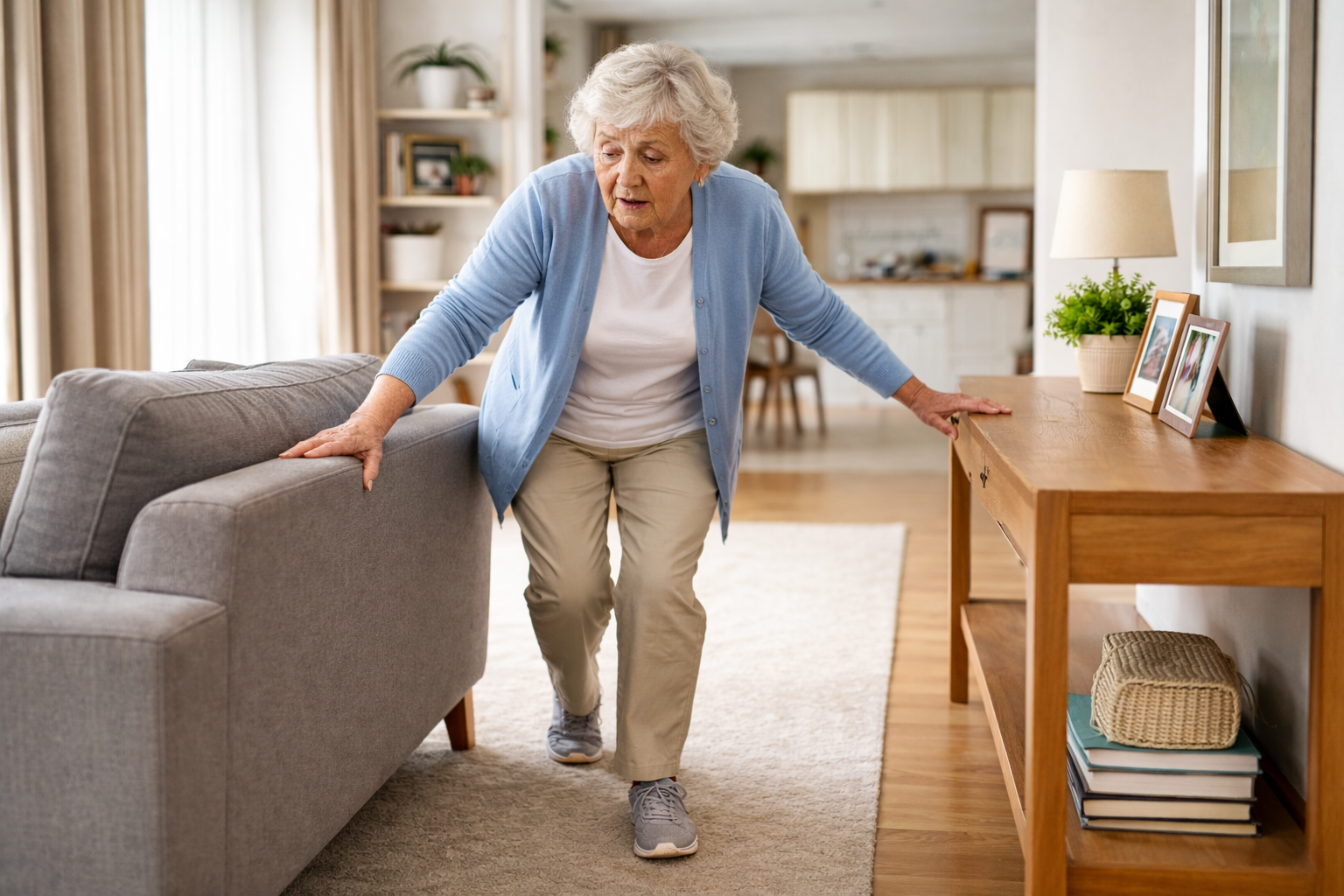
When "Being Careful" Backfires
According to the CDC, about 1 in 4 adults over 65 falls each year, and many never mention it to a healthcare provider. So it makes sense that you might think, "I just need to be more careful." The problem is how your body responds to fear.
When you are afraid of falling, you may:
Take very small steps
Walk with your feet wide apart
Keep your knees and hips stiff
Hold your breath
Stare down at your feet
In small doses, this might feel safer. But over weeks and months, those habits can:
Weaken your leg and core muscles
Reduce your ankle and hip movement
Slow down your reactions
Make it harder to quickly catch yourself if you trip
This is why I say: moving with fearful caution is very different from moving with confident awareness.
Confidence vs Caution - What's The Difference?
Let me be clear: confidence is not recklessness. It is not pretending you are 25 again.
Confidence is:
Knowing what your body can safely do right now
Trusting the strength and balance you have built
Paying attention to your surroundings without panicking
Moving smoothly and fluidly, instead of stiff and braced
Caution, when driven by fear, often looks like this:
Holding onto furniture for every single step
Avoiding going outside, walking in grass, or using the stairs
Turning your whole body in a block, instead of letting your hips and shoulders rotate
Freezing or "locking up" when you feel off balance
The more you avoid, the weaker and less steady you become. The less you move, the scarier movement feels. It becomes a loop.
My job at ProActive Therapy and Wellness is to help you break that loop - gently, gradually, and safely.
How Fearful Movement Increases Fall Risk
Here is what I often see in the clinic. Someone has a fall or a big scare. They start taking tiny steps and keeping their knees bent all the time. Those tiny steps mean the toes are closer to the ground, so it is easier to catch a toe on a rug or crack in the sidewalk. Because the steps are so short, they also have to take more steps to get anywhere. More steps mean more chances for a misstep.
On top of that:
Stiff hips and knees make it harder to step over curbs or small obstacles
A rigid upper body makes turning harder and more awkward
Looking down constantly takes your eyes off what is coming up ahead
Everything is connected. Change the way your feet land, and it changes how your knees, hips, and spine have to respond. Change your posture, and your balance system in the inner ear and neck has to work harder. Fearful patterns ripple through your whole system.
The good news: confident, well-practiced movement patterns can ripple through your system too - in a much better way.
Four Pillars Of Moving With Confidence
At any age, but especially after 65, confident movement rests on four main pillars.
1. Strength you can feel in everyday life
You do not need to be a bodybuilder. You do need enough strength in your hips, thighs, calves, and core to:
Stand up from a chair without using your arms
Climb stairs with control
Catch yourself if you stumble
Functional strength work might include:
Sit-to-stand practice from different chair heights
Step-ups on a low step or curb
Heel raises and toe raises at the counter
A physical therapist can help you find the right starting point so exercises feel challenging but safe.
2. Balance and quick reactions
Static balance (standing still on one foot) is important. But real life is dynamic. You need your body to react when a dog pulls the leash, when a grandchild bumps you, or when you misjudge a step.
Balance training might include:
Shifting your weight side to side and forward/back while holding a counter
Practicing small, quick steps in different directions
Turning your head gently side to side while you walk
The goal is to train your brain and body to respond automatically, without that split-second freeze of fear.
3. Flexibility and posture
Tight muscles can pull you forward and down. Rounded shoulders and a stiff upper back shift your center of mass ahead of your feet, which can make you feel like you are always about to tip.
Gentle stretching and posture work can help you:
Stand taller
See more of your environment
Breathe more easily
When you feel more open and upright, confidence usually follows.
4. Brain-body connection
Balance is not just about muscles. Your eyes, inner ears, and the sensation in your feet all help your brain know where you are in space. Targeted exercises can gently challenge these systems - safely - so they work better together.
For example:
Walking while gently turning your head
Practicing stepping over imaginary lines on the floor
Varying surfaces, such as going from hardwood to a firm rug
If you are living with Parkinson's disease or neuropathy, this kind of training becomes even more important and should be guided by a professional who understands your condition.
Get Started Today
Check out this video for some simple daily practices to build confidence (not fear) for everyday movement.
How Physical Therapy Helps You Rebuild Trust In Your Body
You do not have to figure this out on your own. A physical therapist who works with older adults every day can help you:
Understand why you feel unsteady or fearful
Identify unsafe movement habits you may not even notice
Build a step-by-step plan to improve strength, balance, and confidence
At ProActive Therapy and Wellness here in the Triad region, we focus on helping active adults 50+ and individuals with Parkinson's disease stay strong, steady, and independent.
That can include:
One-on-one therapy tailored to your goals
Group balance and Parkinson's-specific classes
Online courses, including tai chi and yoga-based programs
A video library of educational content and guided movement
We also offer free consultations, where you can sit down with a physical therapist, talk about your concerns, and see if our approach feels like a good fit for you.
You Deserve To Move With Confidence
Aging is real. Changes in strength, balance, and reaction time are real. But living in constant fear of falling does not have to be your new normal.
With the right guidance, you can:
Learn how to move in ways that are safer and more natural
Build the strength and balance that real confidence is built on
Return to activities you enjoy with more trust in your body
If you are in the Summerfield or greater Triad, NC area and you are ready to explore a calmer, more confident way of moving, we would be happy to talk.
To take the next step, you can book a free consultation or call 336-403-9582 to schedule a time that works for you.
You do not have to tiptoe through the rest of your life. You can move with confidence.